Leech Lattice and Conway groups
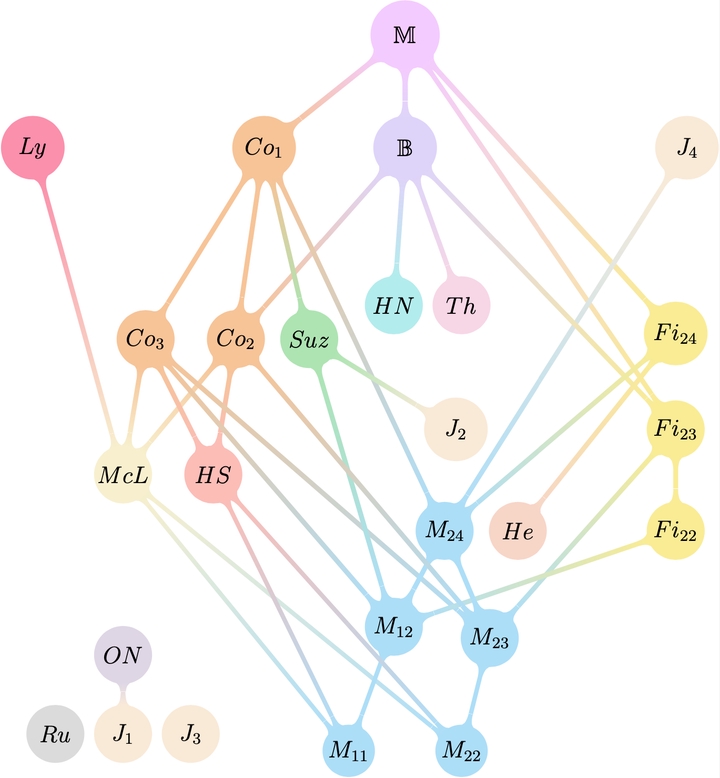 Genetic relation between sporadic finite simple groups
Introduction:
In February 1981, a historic achievement was made by several hundred international mathematicians over a period of thirty years which was completing the classification of finite simple groups. The most interesting of the finite simple groups are the twenty-six sporadic groups. The sporadic groups acquired their name as they do not belong to any infinite family of finite simple groups. The first family of these are the Mathieu groups which consist of $M_{11},$ $M_{12}, M_{22}, M_{23}$ and $M_{24}$; which are permutation groups on $11, 12, 22, 23$ and $24$ points, respectively, and they were discovered by Emile Mathieu in 1861. The second family are the Conway groups which are $Co_1$, $Co_2$ and $Co_3$, they may be considered as automorphism groups of the Leech lattice. They were discovered by John Horton Conway around 1968. Despite the fact that before then the Higman-Sims group $HS$ was discovered by D. G. Higman, C. C. Sims and the McLaughlin group $McL$ was discovered by J. McLaughlin, they are contained in both $Co_2$ and $Co_3$. Meanwhile, the Suzuki group Suz was discovered by Suzuki and the Hall-Janko group $J_2= HJ$ was discovered by Hall-Janko which may be considered as subgroups of the first Conway group. Although the rest of the twenty-six sporadic groups are not discussed in this paper, we introduce them briefly. A century after finding Mathieu’s group, in 1966 Zvonimir Janko found the first Janko group $J_1$ which has only $175560$ elements. During the following decade a further twenty sporadic groups were discovered. In 1974, the largest group of the sporadic groups, the Monster group $M$ or ($F_1$ Fischer-Griess group) was discovered by Fischer. Moerover, in 1980, Griess constructed this group as an automorphism group of $196884$ dimensional algebra that has remarkable commutative but non-associative elements and the order of $M$ was computed by Thompson.
Dr. Maram Alossaimi
Pure Mathematics, Non-commutative Algebras, Poisson Algebras
I am intersted in Poisson algebra, non-commutative algebra and Poisson prime ideals.